IR20: The making of
A research grade pyrgeometer setting new standards
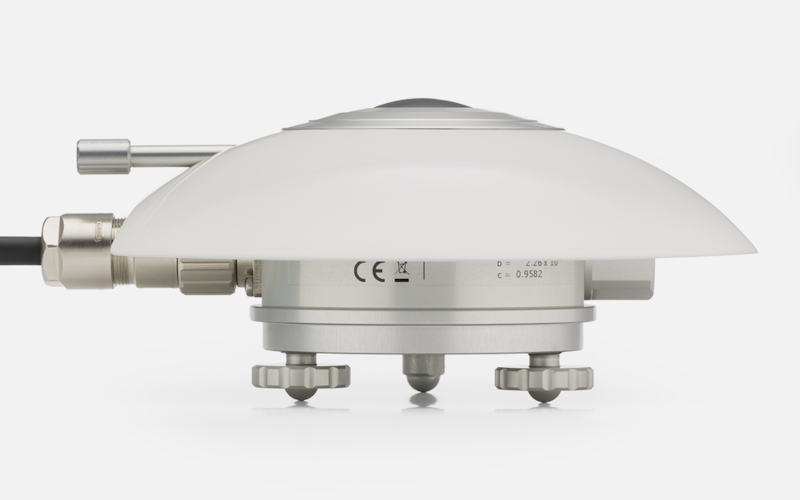
Hukx invested heavily in developing the infrastructure to manufacture, test and calibrate research-grade pyrgeometers. These efforts resulted in the IR20 & IR20WS pyrgeometers, released April 2013.
Objective
The main objective for the IR20 design team was to develop the highest accuracy pyrgeometer to
be sold at a significantly lower price level than competing models of the same performance level.
Result: accuracy
To improve accuracy Hukx mainly focused on reduction of temperature dependence. This has been achieved by a novel approach: first the temperature dependence of the thermopile sensor is accurately determined. As a second step the temperature dependence is entered into the measurement equation. The resulting specification, better than ± 0.4 % across a temperature range of – 30 to + 50 °C, eliminates a major contribution to the measurement uncertainty. The international scientific community is now studying the last few percents of measurement uncertainty. Here the influence of atmospheric moisture content on the spectral properties of the calibration source enters the discussion. To facilitate scientific investigations, each IR20 is supplied with a product certificate, reporting for the individual instrument its filter cut-on (5 %) and two 50 % transmission points.
Comparative testing
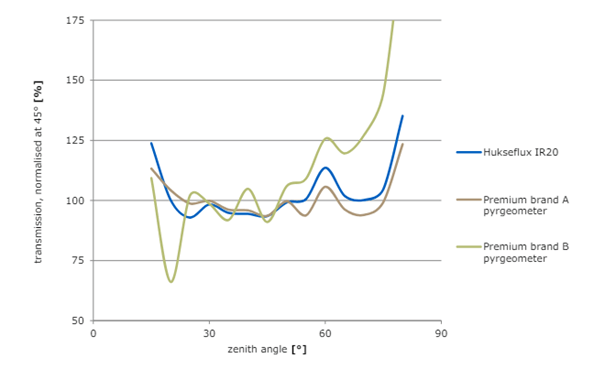
IR20 prototypes and product models were tested outdoor and indoor against competing pyrgeometers. An example of a directional response comparison is shown in Figure 2.
Reference calibration at PMOD
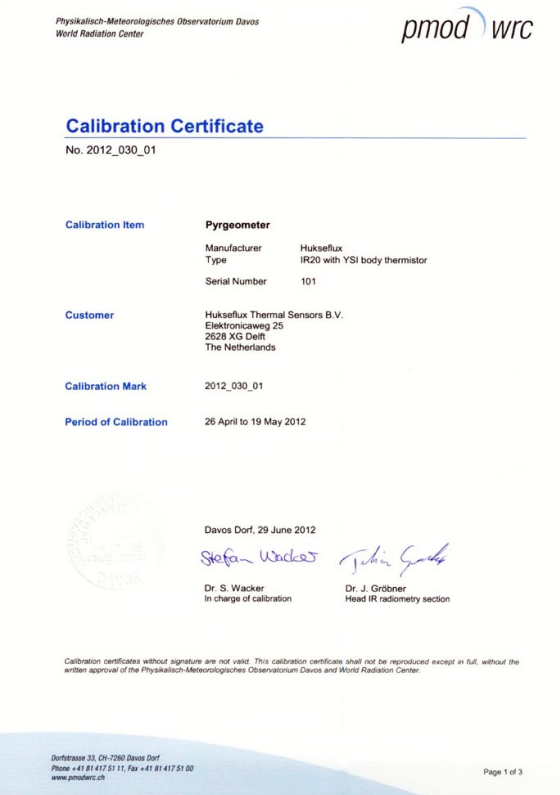
Hukx's internal working standard, the reference for our IR20 calibration, has been calibrated at PMOD World Radiation Center in Davos against WISG (World Infrared Standard Group). See Figure 3.
Pyrgeometers are not subject to a classification standard. Calibration of pyrgeometers is usually traceable to the World Infrared Standard Group This calibration takes into account the spectral properties of downward longwave radiation. As an IR20 option, calibration can be made traceable to a blackbody and the International Temperature Scale of 1990 (ITS-90).
Special: IR20WS wide spectrum model
The spectral range of longwave radiation is not standardized. IR20 has a dome with a solar blind filter with a cut-on at 4.5 x 10⁻⁶m, making it suitable for day and night observations. Model IR20WS has a wide spectral range with a cut-on at 1 x 10⁻⁶m. It offers superior accuracy during night-time, when solar radiation is absent. IR20WS is suitable as well for uncertainty assessments and as a calibration reference.
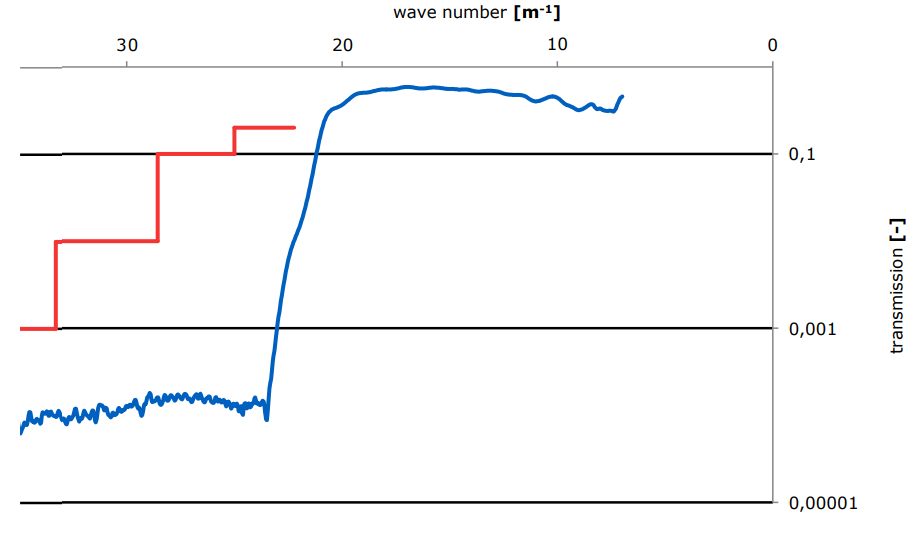
transmission in blue and the design specification in red. The result: well within specifications.
Related products
More application notes
All application notes



We like having a good technical conversation
Do you have questions, need help finding the right solution, or looking to discuss an instrument for a unique application? Our technical engineers provide expert advise. Contact us now!