Independent test confirms SR30 accuracy
NLR’s BORCAL and SSRL BMS data confirm that Hukx SR30 outperforms competition: SR30 delivers superior accuracy compared to competing ISO 9060 Class A pyranometers
Hukx analyzed the independent data from NLR’s BORCAL (Broadband Outdoor Radiometer Calibration) test reports from 2024 and 2025. These measurements show that Hukx pyranometers maintain a remarkably constant responsivity over time and solar zenith angle, with variations below 1 % for the most important range of solar zenith angles and below 2 % over all angles. Competing pyranometer brands within the same ISO 9060 Class exhibit variations that are 3 to 7 times higher, leading to higher measurement errors and uncertainty. The better stability of Hukx instruments translates directly into lower uncertainty and more reliable solar radiation data. This underscores that ISO 9060 classification should not be the only criterion when selecting a pyranometer: there is a lot of variation in accuracy between sensors in the same Class.
Introduction
Accurate solar radiation measurements are essential in PV performance monitoring and meteorology. Over the past decades, pyranometers have become increasingly advanced and optimized, decreasing measurement uncertainty. While most users rely on ISO 9060 classification when selecting a pyranometer, with Class A the most accurate class, uncertainty depends on more than just this label.
For example, the Hukx SR30 and SR300 specifications are better than the Class A limits for 8 out of the 11 classification parameters of ISO 9060, demonstrating performance well beyond the minimum Class A requirements. On the other hand, some manufacturers publish specifications that seem difficult to reconcile with measured data, raising questions about their ISO compliance.
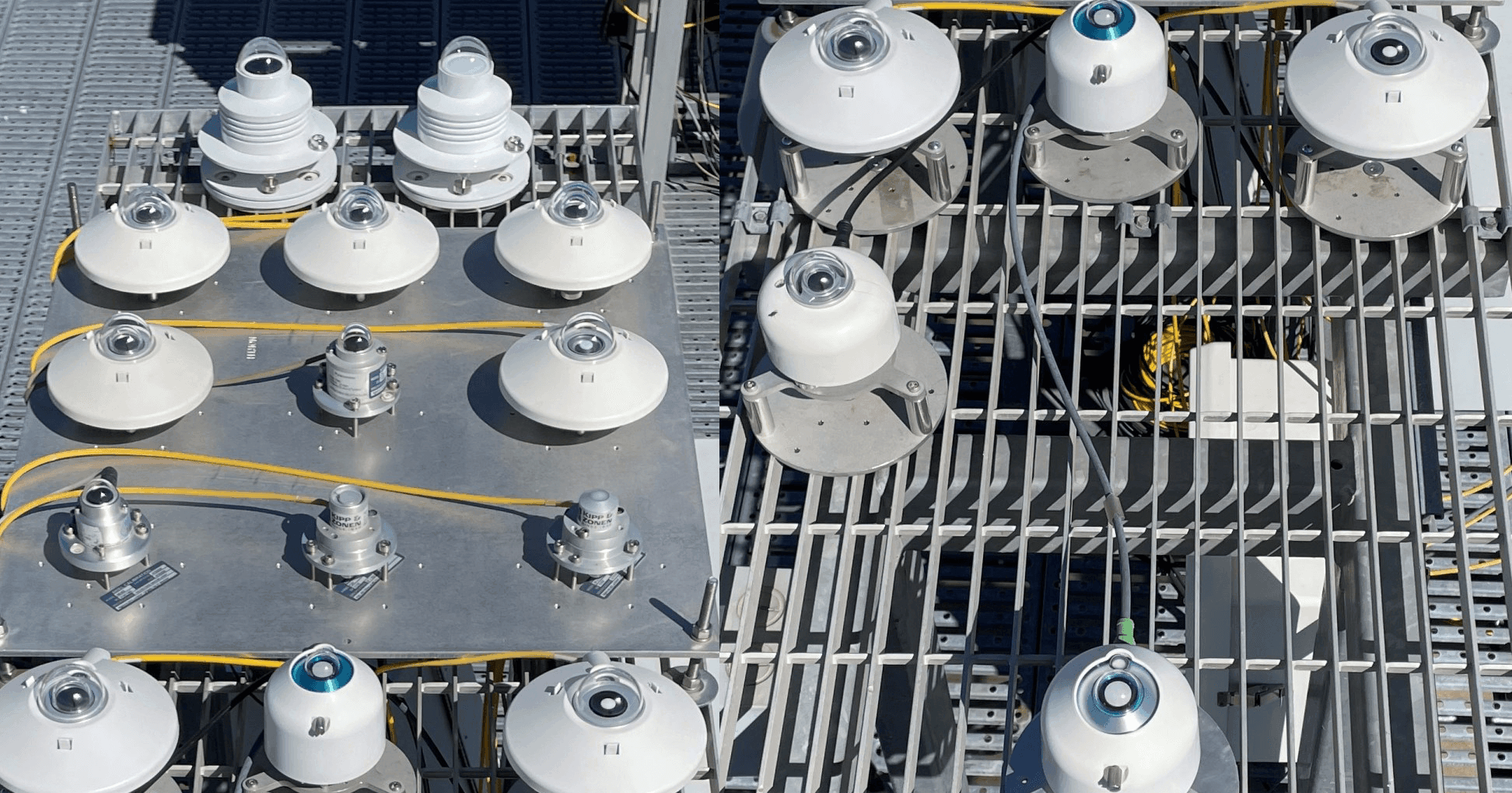
To move beyond marketing claims, independent testing is essential. The U.S. National Laboratory of the Rockies (NLR) offers this through its Broadband Outdoor Radiometer Calibration (BORCAL) program, which is primarily a calibration procedure but also provides a unique basis for comparing different pyranometers based on independent data. BORCAL calibration campaigns in 2024 and 2025 featured the Hukx SR30 alongside competitor models, offering the possibility for direct comparison under the same conditions. The results clearly show the differences in sensor accuracy, highlighting that relying solely on ISO 9060 Class is not sufficient when selecting a pyranometer.
BORCAL procedure
NLR created their own outdoor calibration procedure for irradiance sensors: Broadband Outdoor Radiometer Calibration (BORCAL). It is an ISO IEC 17025 accredited and peer reviewed procedure for outdoor pyranometer calibration, which happens from sunrise to sunset under clear-sky conditions. An absolute cavity pyrheliometer and two shaded sapphire-dome Hukx SR25 pyranometers constitute a reference for the direct normal irradiance (DNI) and diffuse horizontal irradiance (DHI) respectively. By summing the horizontal component of the DNI with the DHI, the traceable reference GHI is obtained. All instruments—reference and those to be calibrated—are thoroughly cleaned and precisely levelled before the calibration. Moreover, this is done by a reputable and independent institute, guaranteeing high-quality measurements that are suitable for fair, direct comparison.
For every measurement, the ratio of instrument output voltage to reference GHI is determined. This responsivity is then plotted as a function of solar zenith angle. From a fit to these data, a single responsivity at 45 ° zenith angle is determined. This angle is used because it is representative of the average solar zenith angle for many locations, therefore capturing a typical response.
Ideally, responsivity would not depend on the solar position and time-of-day, so that a constant responsivity is found. Since only one responsivity is programmed into the sensor, every deviation from that responsivity induces errors in the measurement. In practice, pyranometers suffer from directional response errors, causing slight variations in responsivity depending on the incident angle of the light. These become apparent in the BORCAL data and are compared between pyranometer models.
BORCAL responsivity results
Figure 2 shows the responsivity of Hukx’s model SR30 and two competing pyranometer models as a function of solar zenith angle. The responsivities of Kipp & Zonen’s model SMP12 and EKO’s model MS-80S vary by over 15 and 11 % versus zenith angle. In contrast, SR30’s responsivity only varies by up to 1.8 %, which is more than 6 times better. At small zenith angles, SR30 outperforms the other models by a factor of 4.
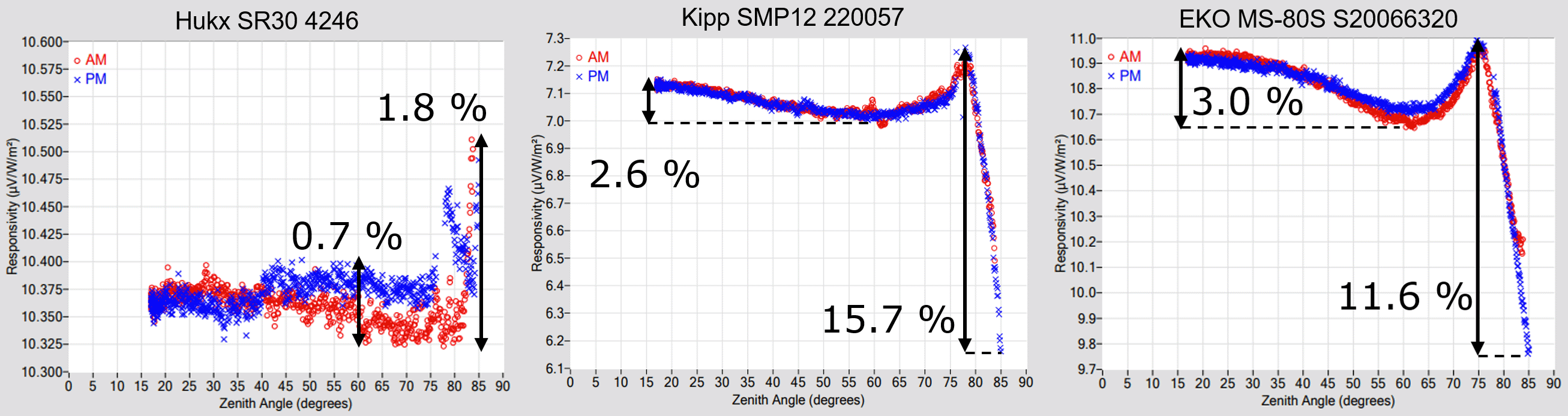
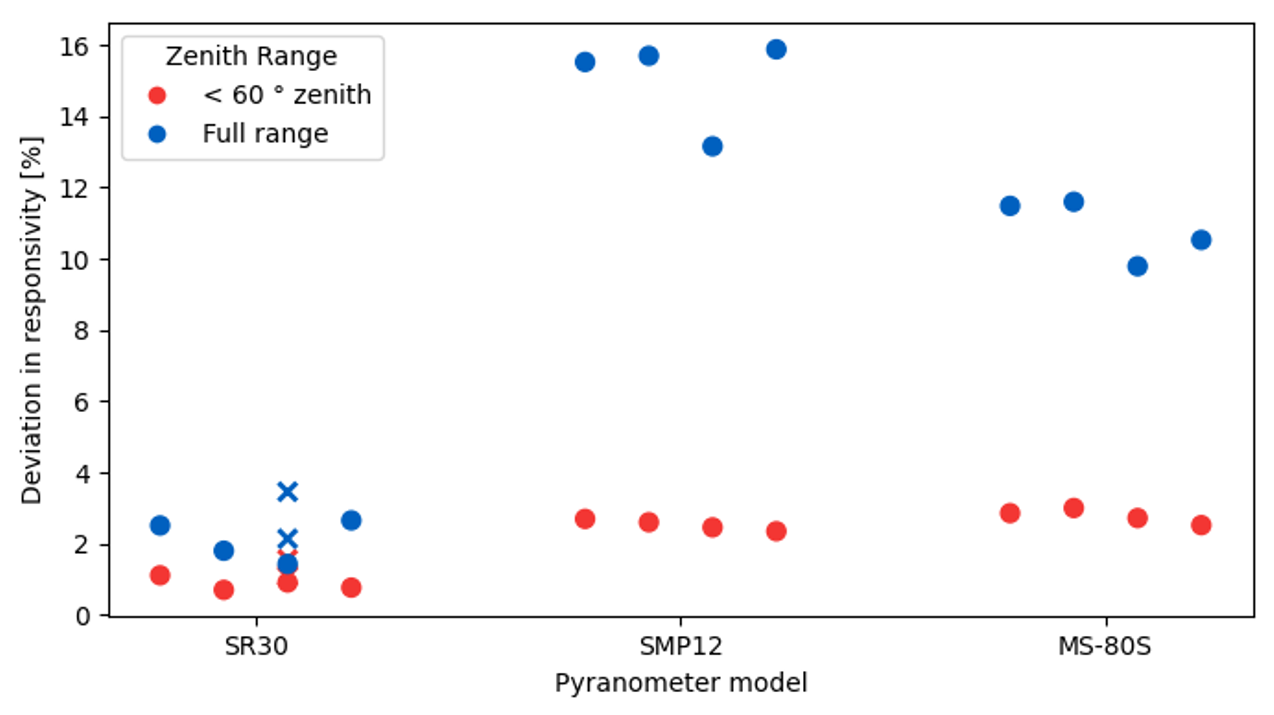
Figure 3 shows the deviations in responsivity for the different BORCAL campaigns and models for the range below 60 ° zenith and the full zenith range, comparable to the arrows in Figure 2. The SR30 structurally performs better for both ranges. For zenith angles below 60 °, the deviation in responsivity is on average 3 times lower than for the SMP12 and MS-80S. For the full range, the deviation is on average 7 and 5 times lower than for the SMP12 and MS-80S. Two additional SR30 sensors were included in BORCAL report 2024-04. These perform comparable to the SR30 with serial number 4246 (Figure 3).
The major fluctuations in responsivity indicate a strong angular dependence on the SMP12 and MS-80S pyranometers. This means that measurements taken with these sensors suffer from serious systematic errors. In contrast, the SR30 ensures irradiance measurements with a much lower uncertainty. While all pyranometers have been given the same ISO Class A classification by the manufacturer, significant differences in performance are visible.
BORCAL directional response results
The responsivity data provided by BORCAL can be taken one step further to evaluate the directional* error of each sensor. By comparing all measurements to the sensor responsivity at 45 °, which NLR uses as the baseline responsivity, it is possible to quantify how much the sensor’s response deviates as the sun moves across the sky. This effectively transforms the variation in responsivity over time into a measure of directional* response error. Note that this is not a pure directional response since the measurement errors may be partly attributed to other effects like non-linearity, temperature response, spectral error, or offsets; however, it is a good estimate from field data.
Strictly speaking, ISO 9060 defines directional response for incoming direct beam radiation. Because BORCAL measurements include both direct and diffuse irradiance, the resulting errors are slightly reduced compared to a pure direct-beam test. Diffuse irradiance hardly leads to directional errors because it is incident from all directions, averaging out errors. For this reason, the directional* response errors derived here represent a best-case scenario.
* The error may be partly attributed to effects other than directional response like non-linearity, temperature response, spectral error, and offsets.
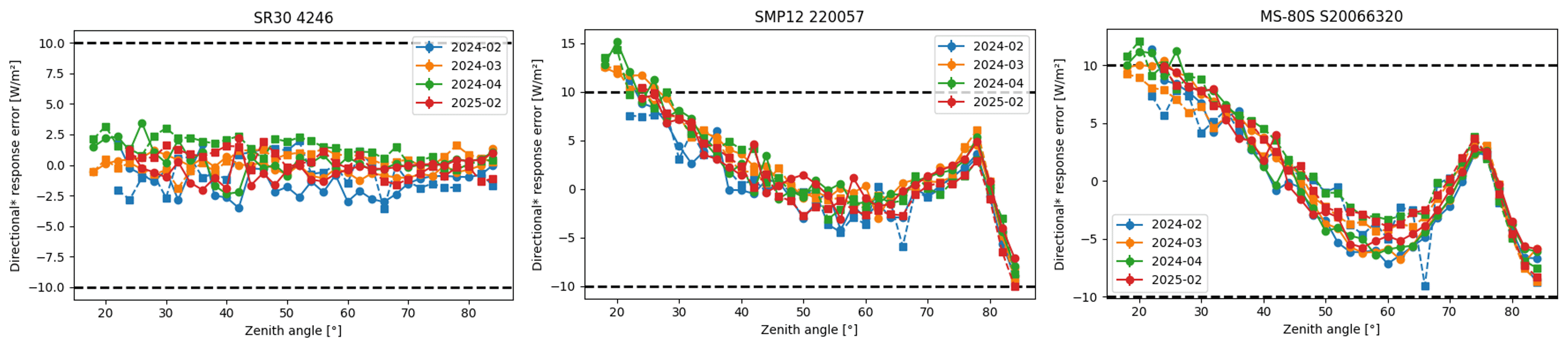
Figure 4 presents the calculated directional* response errors for the different models. The SR30 shows consistently low directional* errors, confirming the stability already visible in its flat responsivity curve (Figure 2). In contrast, the MS-80S and SMP12 exhibit significantly higher directional* errors, approaching or exceeding both the upper and lower limit for pure directional response error.
Importantly, if the diffuse component were removed—as in the ISO definition—the directional* response errors would be even larger. This raises doubt whether the directional response of competitor’s models always remains within ISO 9060 Class A limits. However, no conclusions can be drawn based on this analysis because other error sources than directional response error can propagate into these measurements.
Nevertheless, even if the Class A limits are not exceeded, the found difference in accuracy is striking. This demonstrates that a Class A label does not guarantee identical quality—there are significant performance differences between instruments with the same ISO classification.
The performance gap can be linked to differences in optical design between the models: while the SR30 employs a traditional double-dome construction, the SMP12 and MS-80S use a combination of a single dome and a diffuser. The similarities in design between those two diffuser instruments also become clear when comparing the shape of responsivity and directional response error curves (Figure 2 and 4). This shape is characteristic of the diffuser design.
It is widely acknowledged that it is difficult to ensure a low directional response for diffuser (“fast response”) instruments. This is reflected by the BORCAL results: despite the presence of diffuse light that should reduce apparent errors, substantial angular deviations remain.
Because the directional response error is the most significant contributor to the total measurement uncertainty for modern pyranometers, these results are highly significant for the total measurement uncertainty. The error directly propagates into the uncertainty of key performance metrics such as the Performance Ratio (PR).
Independent validation
In August 2025, PV Performance Labs, at the request of Hukx, analyzed measurements collected by NLR at the Solar Radiation Research Laboratory (SRRL) at their Baseline Measurement System (BMS). These measurements were not part of a BORCAL campaign. At SRRL, instruments are well-maintained and cleaned daily, and the resulting data are made publicly available.
Figure 5 presents the directional* response estimates of several pyranometers based on PV Performance Labs’ analysis of data from June 18, 2025. Note that the SMP12, MS-80S and SR30 are the same units that were used in the BORCAL campaign. In fact, the BORCAL measurements were performed to calibrate these sensors for their use in the Baseline Measurement System.
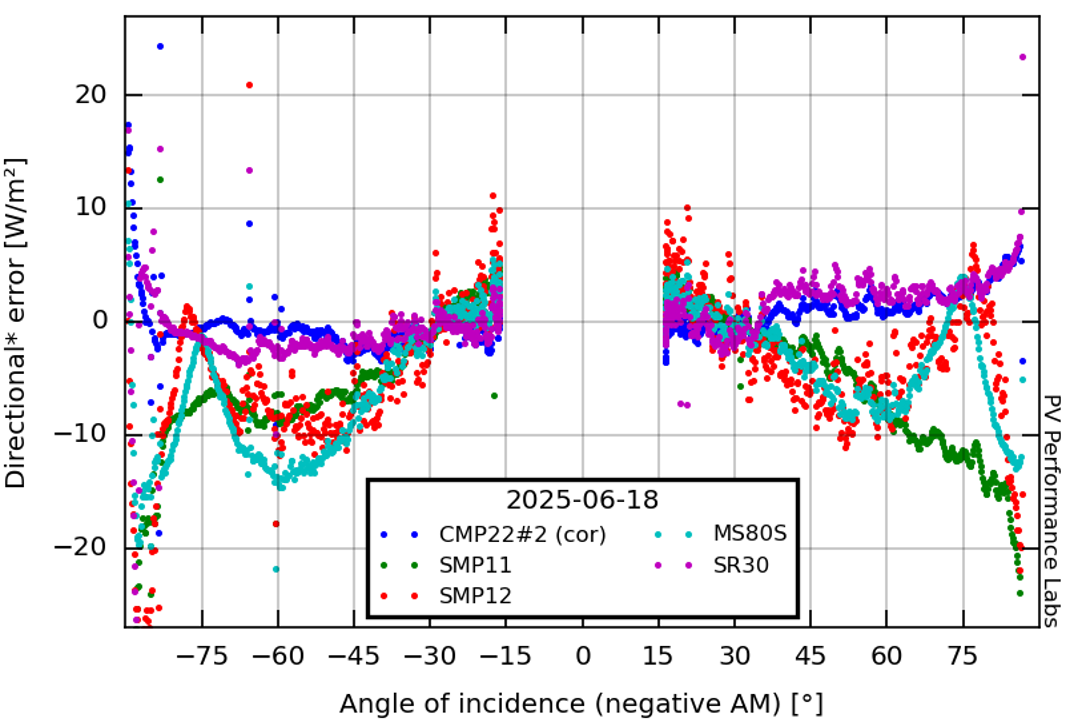
The results confirm earlier findings: the SR30 again outperforms both the SMP12 and the MS‑80S and performs on par with the quartz-dome CMP22. Results are not identical to the BORCAL estimates of directional* response because here corrections are applied for the diffuse part of the incoming radiation. This illustrates that the previous estimates based on BORCAL data were indeed conservative and can be considered as best-case values. Furthermore, it shows again that ISO Class on itself is not a sufficient selection criterion.
Taken together, the BORCAL results and this independent analysis of SRRL data lead to the same conclusion: the SR30 provides more accurate measurements than its Class A competitors, SMP12 and MS-80S.
Hukx finds these results are representative for all SR30, SR300, SMP12 and MS-80S. Indoor tests of MS-80S and SMP12 performed at Hukx yield similar patterns, and directional response characteristics with significant errors, owing to the diffuser design of these instruments.
SR300 is the successor of the SR30 and Hukx’s newest top-of-the-line pyranometer.
With identical optics, customers can expect performance at least equal to, but likely better than that of the SR30. The S300 provides solar radiation data with the lowest uncertainty, reducing financial risks in solar projects.
References
A. Andreas, BORCAL-SW Calibration Report 2024-02, National Laboratory of the Rockies (NLR), Solar Radiation Research Laboratory, Golden, Colorado, May 21, 2024.
A. Andreas, BORCAL-SW Calibration Report 2024-03, National Laboratory of the Rockies (NLR), Solar Radiation Research Laboratory, Golden, Colorado, June 7, 2024.
A. Andreas, BORCAL-SW Calibration Report 2024-04, National Laboratory of the Rockies (NLR), Solar Radiation Research Laboratory, Golden, Colorado, July 9, 2024.
NLR-SRRL-BMS, BORCAL-SW Calibration Report 2025-02, National Laboratory of the Rockies (NLR), Solar Radiation Research Laboratory, Golden, Colorado, May 5, 2025.
A. Andreas; T. Stoffel; (1981). NLR Solar Radiation Research Laboratory (SRRL): Baseline Measurement System (BMS); Golden, Colorado (Data); NLR Report No. DA-5500-56488. http://dx.doi.org/10.5439/1052221
Related products
More application notes
All application notes


We like having a good technical conversation
Do you have questions, need help finding the right solution, or looking to discuss an instrument for a unique application? Our technical engineers provide expert advise. Contact us now!