How to measure albedo for bifacial PV
Hukx is the market leader in albedometers for bifacial PV system performance monitoring
Measuring the albedo of surfaces, or ground surface reflectance, is becoming increasingly important. Bifacial PV modules generate power from both the global solar radiation and the reflected solar radiation. Downfacing pyranometers can be used to make reflected radiation measurements, but it is essential to consider what the performance model requires as input: the ground surface property or reflected irradiance? This note provides guidance on instrument specifications, measurement location, and orientation.
Introduction
Albedo, also called solar reflectance, is defined as the ratio of reflected to global radiation. It is a dimensionless number less than 1 and a property of the ground surface.
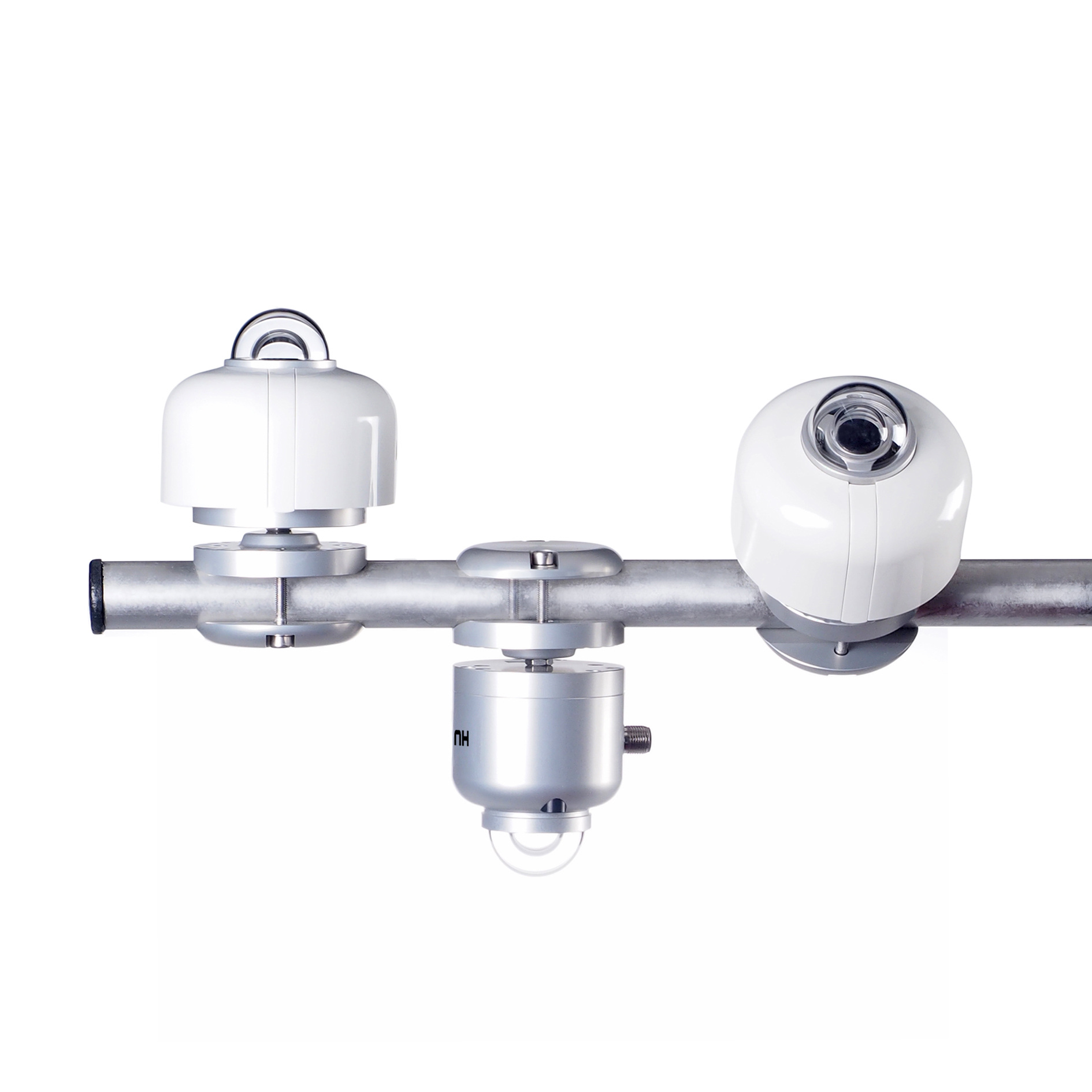
An albedometer is an instrument that measures both global and reflected solar radiation and, by calculation, the solar albedo—or solar reflectance—for a particular ground surface. An albedometer is composed of two pyranometers, both installed horizontally, with the downfacing one measuring reflected solar radiation.
In the open field, solar albedo depends on the directional distribution of incoming radiation and on surface properties at ground level. It is usually expressed as a single number, determined by taking an average over a day. Changes of albedo are typically slow and seasonal, except when it snows. Albedos of typical surfaces range from about 4 % for fresh asphalt and 15 % for green grass to 90 % for fresh snow.
The classic application of albedometers is in meteorological energy balance studies, studying albedo variations of large areas over multiple years. With the rise in popularity of bifacial PV modules, there is an increased demand to measure the albedo at PV power plants. This is possible with pyranometers, but there are several considerations to keep in mind.
Recommendations in summary
A summary of Hukx’s recommendations for albedo measurement with bifacials:
- Keep the albedo definition simple: most models assume it is a ground surface property with a seasonal (monthly) variability. Let the model take care of corrections for shading patterns and conversion to Plane of Array.
- Employ at least one instrument located away from the array to have one unobstructed reference albedo measurement. This assumes that the ground surface properties at the station are representative of those between the arrays.
- Keep logistics simple. Use the same instruments for POA, GHI, and RI measurements. These are typically spectrally flat Class A (secondary standard) pyranometers, which can also share the same calibration services.
- Use either 2 x single pyranometers or modular instruments consisting of 2 x pyranometer for easier servicing and recalibration.
- Consider performing surveys for site characterization in different seasons (also relative to the unobstructed reference station) to determine ground surface properties. This is required for uncertainty evaluation.
- As an alternative for surveys, consider using multiple instruments between the arrays to verify model calculations of reflected irradiance and assess its spatial variability. When using multiple instruments between rows, you may also employ lower accuracy (spectrally flat Class B or C) instruments. Typically, these instruments are installed horizontally facing down, though in some cases users choose to install in POA.
- Do not install pyranometers for RHI measurement below 1 m height; 1.5 m is a good and practical compromise.
- For personnel safety, electrically insulate the instrument body from PV array mounting frames.
- After snowfall, do not use the values measured by an unobstructed reference albedo measurement station. An unobstructed station will not have snow patterns representative of those between arrays.
Performance model, ratio and index
The new IEC 61724 Photovoltaic System Performance series of standards is the best available source that defines parameters such as “performance ratio” and “performance index.” IEC uses the following definitions:
- performance model: a mathematical description of the electrical output of the PV system as a function of meteorological conditions, the system components, and the system design. This model is typically agreed upon in advance by the stakeholders of the test.
- predicted output: the output for a given period as calculated using the performance model based on historical weather data
- expected output: the output calculated using the performance model when entering measured weather data
- rating: performance as specified by the manufacturer, usually confirmed via the nameplate on the panel, or as agreed upon by a supplier, typically under reference conditions such as Standard Test Conditions (STC)
- performance ratio (PR): the ratio of measured output to expected output for a given reporting period, based on the system nameplate rating
- performance index: the ratio of measured output to expected output for a given reporting period, based on a more detailed model of system performance than the performance ratio
Site survey on a sunny day
To investigate the characteristics of the site, users may perform a site survey. During the survey, you can walk around with an albedometer and measure at different locations. Under stable solar conditions, you may also use a single pyranometer and invert it.
The purpose of such survey is to investigate:
- spatial variability of the (ground surface) albedo
- seasonal variability of the albedo
- correlation between a field station and the conditions at the arrays
At the location of all POA measurements, IEC 61724-3, clause 5 requires measurement of the local albedo to verify that it is representative of the albedo of the total power plant, fits the assumptions made in modeling, and to use the measurements in the uncertainty evaluation of the performance test.
Recommendations and boundary conditions for the survey are:
- Choose a sunny day, with limited cloud cover and solar elevations above 60 degrees.
- Focus on measuring the ground surface properties: measure above unshaded locations with a representative ground surface or vegetation.
- Measurements in shaded locations typically provide a signal level that is too low to make a good albedo estimate.
- In case there is seasonal vegetation, measure 2–4 times throughout the year.
- Use an albedometer, or under stable solar conditions, use a single pyranometer and invert it.
Related products
More application notes
All application notes


We like having a good technical conversation
Do you have questions, need help finding the right solution, or looking to discuss an instrument for a unique application? Our technical engineers provide expert advise. Contact us now!