How the ISO 9060 standard impacts solar radiation measurement in PV monitoring and meteorological applications
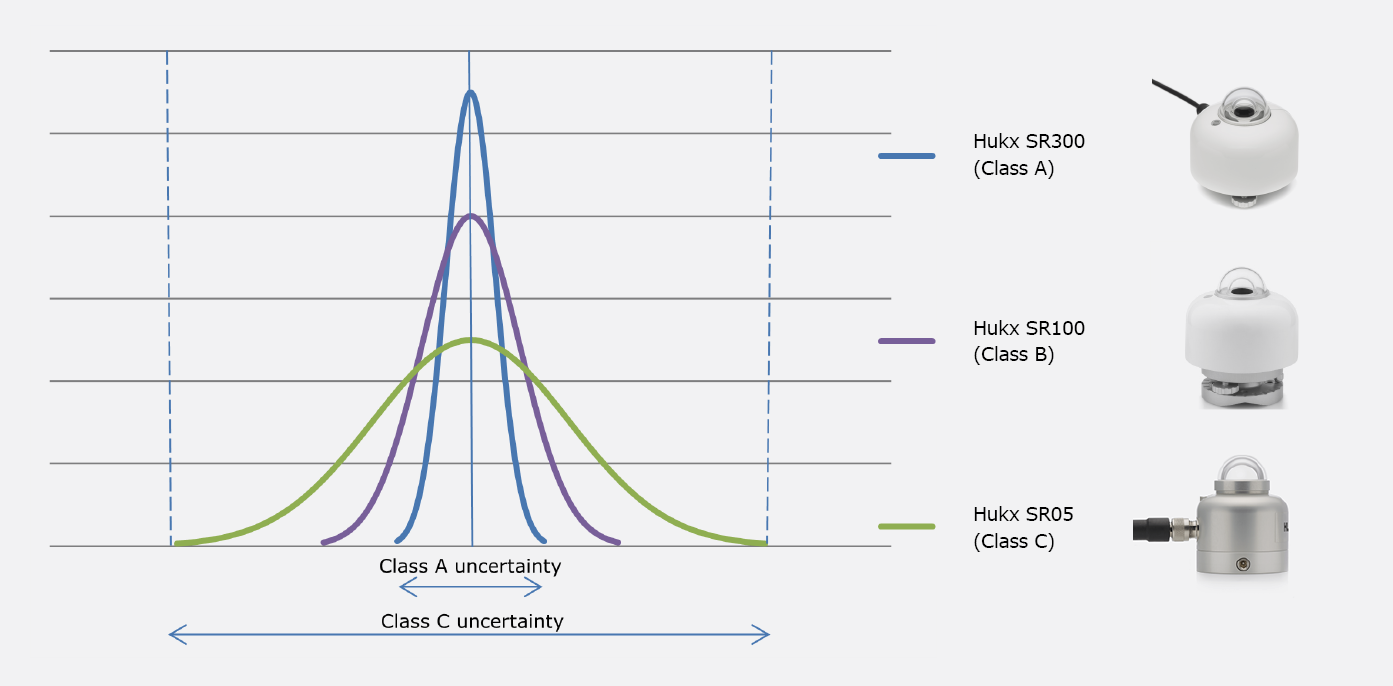
Pyranometers are reference sensors for measuring solar radiation and are used in PV system performance monitoring and meteorology. ISO 9060, which was revised in 2018, is the globally recognised standard that defines pyranometer classification. It distinguishes three accuracy classes: Class A, B, and C. The measurement uncertainty approximately decreases by a factor of 2 from Class C to B and Class B to A. A pyranometers belongs to a certain Class if all specification and classification criteria are met. Furthermore, ISO 9060 defines the additional properties “spectrally flat” and “fast response”. It is important to note that pyranometer selection should not only rely on ISO Class, since there are significant differences in attained measurement accuracy even within a Class.
This note also highlights best practices from ASTM G213-17 and ISO/TR 9901 for estimating and minimizing measurement uncertainty to ensure reliable solar irradiance data. In addition, the IEC 61724-1 standard for PV system performance monitoring explicitly requires the use of ISO 9060-compliant pyranometers.
Introduction
ISO 9060: Solar energy—Specification and classification of instruments for measuring hemispherical solar and direct solar irradiance—is the globally recognized standard that defines pyranometer specification and classification. The first version of the standard dates back to 1990. In 2018, a major revision was made. This revision was not only an update in terminology, but it also raised the bar for compliance to an accuracy class.
Pyranometer classification
Pyranometers are classified according to ISO 9060 in 3 accuracy classes: Class A, Class B, and Class C. A pyranometer belongs to a specific class if all specifications of the respective class and all classification criteria are unambiguously met. Table 1 summarizes the specification criteria for compliance to an accuracy class. For detailed definitions of the parameters, please refer to the standard. A short explanation of the parameters is given below:
- Response time (95 %): the time interval after a step change in light until the pyranometer signal reaches and remains within 95 % of its final value.
- Zero offset a: response to -200 W/m2 net thermal radiation.
- Zero offset b: response to 5 K/h change in ambient temperature.
- Zero offset c: total zero offset, including the effects of zero offset a, zero offset b, and other sources.
- Non-stability: percentage change in responsivity per year.
- Nonlinearity: percentage deviation from the responsivity at 500 W/m2 due to the change in irradiance within 100 W/m2 to 1 000 W/m2.
- Directional response: the range of errors caused by assuming that the normal incidence responsivity is valid for all directions when measuring from any direction (with an incidence angle of up to 90 ° or even from below the sensor) a beam radiation whose normal incidence irradiance is 1 000 W/m2.
- Non-stability: percentage change in responsivity per year.
- Nonlinearity: percentage deviation from the responsivity at 500 W/m2 due to the change in irradiance within 100 W/m2 to 1 000 W/m2.
- Directional response: the range of errors caused by assuming that the normal incidence responsivity is valid for all directions when measuring from any direction (with an incidence angle of up to 90 ° or even from below the sensor) a beam radiation whose normal incidence irradiance is 1 000 W/m2.
- Clear sky global horizontal irradiance spectral error: maximum spectral error observed for a set of global horizontal irradiance clear sky spectra defined in ISO 9060.
- Temperature response: percentage deviation due to change in ambient temperature within the interval from -10 °C to 40 °C relative to the signal at 20 °C.
- Tilt response: percentage deviation from the responsivity at 0 ° tilt (horizontal) due to change in tilt from 0 ° to 180 ° at 1 000 W/m2 irradiance.
Table 1 Pyranometer specification criteria according to ISO 9060:2018. Individual parameters are explained in the main text. The listed
values represent acceptance intervals for each parameter. For accompanying guard bands, see the standard.
| PYRANOMETER SPECIFICATION ACCORDING TO ISO 9060:2018 | ||||
| Class A (previously secondary standard) | Class B (previously first class) | Class C (previously second class) | Hukx SR300, SR200 (Class A) | |
| response time (95 %) | < 10 s | < 10 s | < 10 s | 3 s |
| zero offset a | ± 7 W/m2 | ± 15 W/m2 | ± 30 W/m2 | < ± 2 W/m2 (SR300) < ± 5 W/m2 (SR200) |
| zero offset b | ± 2 W/m2 | ± 4 W/m2 | ± 8 W/m2 | < ± 2 W/m2 |
| zero offset c | ± 10 W/m2 | ± 21 W/m2 | ± 41 W/m2 | < 5 W/m2 |
| non-stability | ± 0.8 % | ± 1.5 % | ± 3 % | < ± 0.5 % / yr |
| nonlinearity | ± 0.5 % | ± 1 % | ± 3 % | < 0.2 % |
| directional response | ± 10 W/m2 | ± 20 W/m2 | ± 30 W/m2 | < ± 10 W/m2 |
| clear sky GHI spectral error | ± 0.5 % | ± 1 % | ± 5 % | < ± 0.5 % |
| temperature response | ± 1 % | ± 2 % | ± 4 % | < ± 0.4 % |
| tilt response | ± 0.5 % | ± 2 % | ± 5 % | < ± 0.2 % |
| additional signal processing errors | ± 2 W/m2 | ± 5 W/m2 | ± 10 W/m2 | none (signal processing errors are included in other specifications) |
Changes in the 2018 revision
Here are the key changes to the standard in the 2018 revision compared to the 1990 version.
The 2018 version of ISO 9060 includes:
- 3 instrument accuracy Classes: A, B and C (previously secondary standard, first class and second class)
- a special addition to every Class: “spectrally flat”. This addition applies to sensors that respond equally to all wavelengths of incoming sunlight and is recommended for Plane of Array, albedo, and Rear-side Plane of Array measurements. For the addition “spectrally flat”, it is required that the spectral selectivity (the percentage deviation of the spectral responsivity from the corresponding mean within the range 0,35 µm and 1,5 µm) is lower than 3 %.
- a special addition to every Class: “fast response”. This addition applies to pyranometers that have a low response time and is recommended when measuring highly variable data such as over-irradiance events. For the addition “fast response”, the sensor’s response time needs to be below 0.5 s.
- a new parameter for pyranometer class assessment: spectral error (in contrast to the previous assessment parameter: spectral selectivity)
- a requirement for individual testing of both temperature response and directional response for Class A pyranometers
Limits and guard bands
ISO 9060:2018 specifies the numbers in Table 1 as acceptance limits for each listed parameter. These limits are deliberately chosen narrower than the corresponding tolerance limits (the ranges within which the device under test is expected to perform) to account for measurement uncertainty and to reduce the risk of a false decision. The gap between the tolerance limit and acceptance limit is known as the guard band. ISO 9060:2018 defines such guard bands for all properties included in Table 1 of the standard. Guard bands are not included in this note.
What is an accuracy class?
ISO 9060 defines three accuracy classes for pyranometers: Class A, Class B and Class C. The concept of an accuracy class is defined by the International Vocabulary of Metrology (VIM), paragraph 4.25, as “class of measuring instruments or measuring systems that meet stated metrological requirements that are intended to keep measurement errors or instrumental uncertainties within specified limits under specified operating conditions”.
Compliance with an accuracy class is sufficient to claim a certain measurement uncertainty by comparison to other systems of the same class according to the Guide to the Expression of Uncertainty in Measurement (GUM), type B evaluation of uncertainty, see also VIM paragraph 2.29.
Pyranometer accuracy
From Class C to Class B and from Class B to Class A, the measurement uncertainty of pyranometers approximately decreases by a factor of 2. See Figure 2 for an impression of measurement accuracy for the different pyranometer classes.
A general rule: the higher the required accuracy:
- the higher the cost of the instrument
- the higher the required level of maintenance (cleaning)
- the higher the required accuracy of calibration
In many cases the specifications of Hukx pyranometers are much better than the Class requires (see Table 1). This than results in better measurement accuracy than estimated just based on the classification. Table 2 shows an overview of Hukx pyranometers and their classification.
Table 2 Hukx pyranometers and their ISO 9060:2018 class and IEC 61724‑1:2021 compliance.
| BRAND | MODEL | ISO 9060:2018 CLASS | IEC 61724-1:2021 COMPLIANCE |
| Hukx | SR30, SR300 | Class A | Class A for all locations and conditions |
| Hukx | SR20, SR200 | Class A | Class A only for locations where dew and frost are expected less than 2% of the time |
| Hukx | SR100 | Class B | Class A for rear-side plane of array irradiance Class B for other irradiance measurements |
| Hukx | SR05 | Class C | Class A for rear-side plane of array irradiance Class B for other irradiance measurements |
Related products
More application notes
All application notes


We like having a good technical conversation
Do you have questions, need help finding the right solution, or looking to discuss an instrument for a unique application? Our technical engineers provide expert advise. Contact us now!