
Whether it’s for buildings, HVAC systems, or vehicles, ensuring proper thermal insulation is crucial for achieving high energy efficiency, reducing operating costs, and maintaining thermal comfort. Assessing the thermal insulation capabilities of a system is often non-trivial, since insulation systems typically use multiple layers of different materials. Hukx has developed several ranges of heat flux sensors that make thermal insulation performance assessments accurate and straightforward.
Why thermal insulation matters
Thermal insulation directly affects many factors, such as:
- Energy efficiency: Proper insulation minimizes heat loss or gain, reducing the energy required for heating or cooling. It also contributes to a building’s compliance to local energy-saving regulations.
- Operating costs: A reduced energy consumption leads to a lower energy bill, which is both good for your budget and the environment. Proper insulation is a smart long-term investment.
- Thermal comfort: With an effective thermal insulation system, you ensure that people inside the insulated environment are comfortable.In critical environments such as working spaces, ensuring proper thermal comfort is essential. Additionally, in the colder seasons and in extreme climate conditions, thermal comfort becomes an important factor.
Selecting the right thermal insulation system depends on many factors. Hukx’s heat flux sensors provide reliable and accurate data to help you make informed decisions.
Measuring thermal insulation performance
Heat travels through materials by conduction, insulation performance depends on the material’s ability to resist this heat flow. This can be quantified with the R-value, which is the thermal resistance. This property can be calculated by dividing the temperature difference across the material by the measured heat flux. High thermal resistance indicates better insulation performance. Higher thermal resistance can be achieved by increasing the volume or weight of the material, and some materials have inherently higher thermal resistances than others. Hukx provides a range of heat flux sensors to accurately calculate the thermal resistance of thermal insulation systems.
Our heat flux sensors
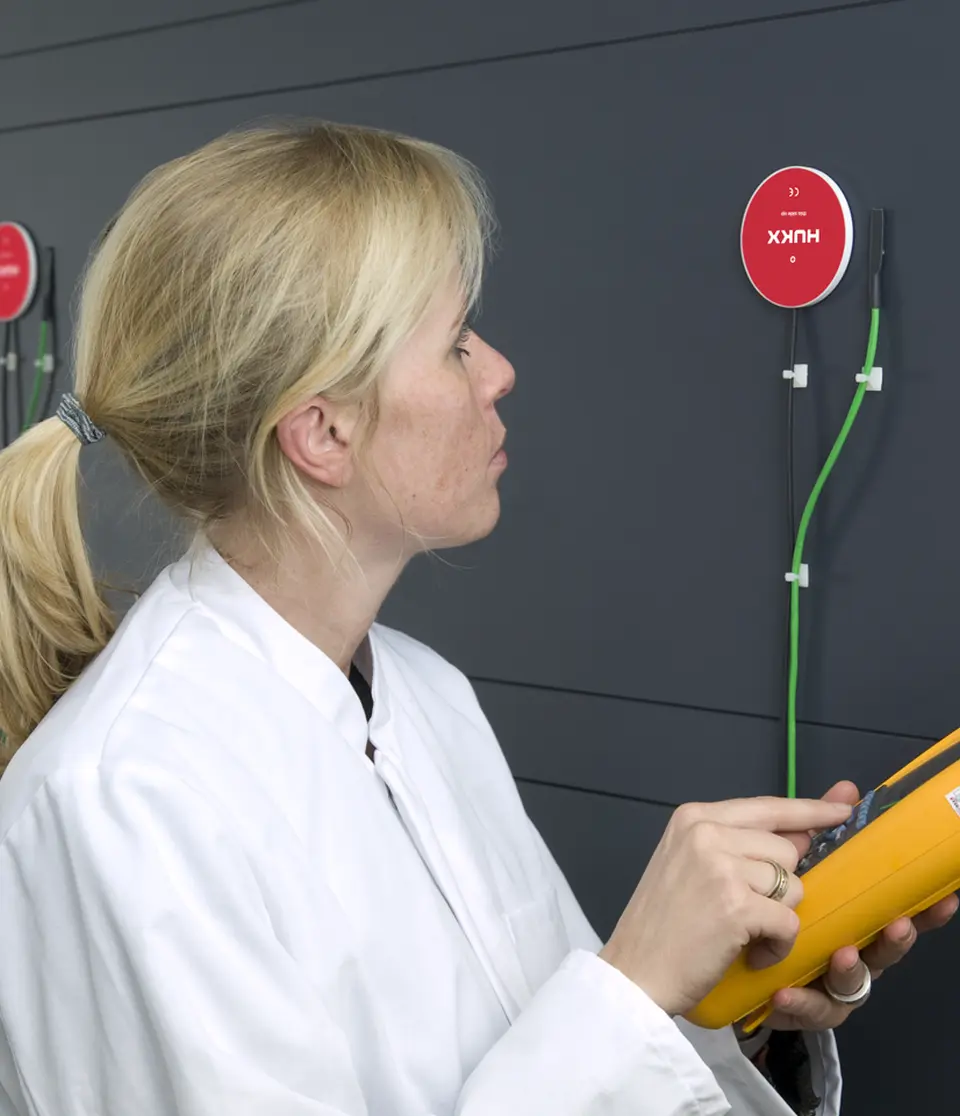
Hukx has developed various heat flux sensors to assess the performance of thermal insulation. These sensors are based on thermopiles, which measure the temperature across the sensor body and convert this into a measurable voltage. This temperature difference across the sensor is linearly proportional to the heat flux through the sensor’s surface. This way, they measure the heat flux through the object in which they are incorporated in or mounted on. The two most popular ranges for examining thermal insulation systems are:
- HFP series: Our heat flux plate (HFP) sensor range is widely used for heat flux measurements through walls and building envelopes. Its total thermal resistance is kept small by using a ceramics-plastic composite body, minimizing the distortions in measurements. All HFP sensors are compliant with ISO 9869 thermal insulation measurement standards.
- FHF series: This series includes five models ranging in dimensions, sensitivities, and temperature ratings. Using patented flexible thermopile foil technology, the FHF-series is the perfect choice for characterizing the thermal insulation performance of new materials and different system geometries.
With Hukx’s heat flux sensors, you can gain reliable and accurate insights on the performance of your thermal insulation system. Apart from heat flux you also need to measure two temperatures. The thermal performance is expressed as “Thermal Resistance” in K/(W/m2). You need to divide the temperature difference by the heat flux.
Advantages
Choosing heat flux sensors from Hukx means investing in high-accuracy data. We offer many other advantages including:
- Proven expertise: At Hukx, we have been designing heat flux sensors since 1993. Over the years, we have been expanding our product lines and we have established ourselves as both technology and market leader.
- Worldwide support: Hukx has specialists available in every major economy.
- Calibration support: We offer calibration support for our sensors worldwide. Heat flux sensors are calibrated in our main office in Delft, The Netherlands.
- Traceability: All sensor calibrations can be formally traced to international standards.
Take a look at our heat flux sensor product lines and related application notes below.
Related products
Related application notes
Suitable data loggers and amplifiers to work with Hukx heat flux sensors
Discover the versatile compatibility of our heat flux sensors
How to install a heat flux sensor
Tips and tricks to get the most out of your heat flux measurement
Heat flux sensor technology:
Printed thermopile conductors vs. Etched-and-plated
Heat flux sensor technology:
Why use sensors with low thermal resistance and with spreaders
Heat flux measurement fundamentals and applications

We like having a good technical conversation
Do you have questions, need help finding the right solution, or looking to discuss an instrument for a unique application? Our technical engineers provide expert advise. Contact us now!