Pyranometer selection guide: how to choose the best sensor for your application
Next-level instruments for every application
As the market-leading pyranometer supplier, Hukx provides general guidelines for choosing the right pyranometer for your needs. Main applications include PV system performance monitoring (according to IEC 61724-1), meteorological networks, and diffuse radiation measurement. Customers prefer Hukx pyranometers for their unsurpassed measurement accuracy and lowest total cost of ownership.
The right instrument for your application
Choosing the right instrument for your application might seem complex, but we are here to help.
First, consider these questions:
- Are there standards for my application?
- What level of accuracy do I need?
- What maintenance will be available?
- What mounting options exist?
- How much electrical power is available?
- What sensor output does my measurement/data acquisition system require?
Your response will help us recommend the best-suited pyranometer, including:
- pyranometer class
- maintenance and calibration policy
- estimated measurement accuracy
- electrical interfacing
- power requirements
- mechanical mounting configuration
Hukx pyranometer benefits
Hukx is the world’s leading pyranometer manufacturer, in both technology and market share. We offer the right pyranometer for every application and budget. With Hukx, you can rely on the best measurement accuracy in every class. Thanks to our superior
instrument design, you can expect:
- unparalleled accuracy in every class
- exceptional reliability, ensuring consistent performance over time
- lowest cost of ownership, by minimizing maintenance costs and extending the product life span
Table 1 provides an overview of pyranometers and the most common considerations for choosing the right instrument for your application. More information on key criteria can be found throughout the rest of this document.
Table 1 The most common considerations when choosing a pyranometer for applications in PV system performance monitoring, meteorological networks, and diffuse solar radiation measurement.
 |  | |  | |
| SR300-D1 | SR200-D1 | SR100-D1 | SR05-D1A3 | |
| ISO 9060 classification | spectrally flat Class A | spectrally flat Class A | spectrally flat Class B | spectrally flat Class C |
| IEC 61724-1 suitability for PV monitoring system Class | Class A Class A for POAREAR and albedo | Class A Class A for POAREAR | Class B Class A for POAREAR | Class B for POA and GHI Class A for POAREAR and albedo |
| diagnostics in data stream: alerts | alerts for:
| alerts for:
| alerts for:
| no alerts |
| heating to mitigate dew and frost/improve data availability | heated | not heated | not heated | not heated |
| tilt sensor included | yes | no | no | no |
| surge immunity and EMC | IEC 61326-1 equipment classification: Industrial Equipment | IEC 61326-1 equipment classification: Industrial Equipment | IEC 61326-1 equipment classification: Industrial Equipment | |
| PV system performance monitoring | +++++ | + | - | - |
| high-accuracy meteorological networks | +++++ | ++++ | +++ | - |
| agro-meteorological networks | + | + | ++ | ++++ |
| diffuse radiation reference (low offset) | +++++ | +++ | ++ | - |
| reflected radiation/albedo measurement (spectrally flat) | +++++ | ++++ | +++ | ++ |
Highest accuracy in every class
Pyranometers are classified according to ISO 9060 in 3 accuracy classes: Class A, Class B, and Class C.
At Hukx, we only supply “spectrally flat” version as they measure accurately under all conditions and can easily be calibrated. From Class C to Class B and from Class B to Class A, the achievable accuracy improves by a factor of 2.
As a general rule, the higher the required accuracy:
- the higher the cost of the instrument
- the higher the required level of maintenance (e.g., cleaning)
- the higher the required accuracy of calibration
Uncertainty evaluation
The ASTM G213-17 provides guidance and recommended practices for evaluating uncertainties when performing outdoor measurements with pyranometers. The ASTM standard follows the ISO Guide 98.
Highest reliability: immunity to high impulse voltages and currents; surges
SR300-D1, SR200-D1, and SR100-D1 are classified for use in Industrial Environments, according to IEC 61326-1 and IEC 61000-6-2. When designing a measuring system, pyranometer users may reach several levels of immunity.
With the optional Surge Protection Device SPD01, this immunity can be increased to 4 kV. Up to 3 pyranometers can be protected with a single SPD01. A third-party SPD with similar specifications may also be used.
To attain the required level of immunity for a given installation, some general system components should be included, such as:
- lightning protection system
- earthing and grounding network
- external surge protection, in addition to the native on-board sensor protection.
Lowest total cost of ownership
Customers prefer Hukx pyranometers for their best-in-class measurement accuracy and lowest cost of ownership. Total ownership costs are primarily determined by installation, on-site inspection, accidental damage, and calibration.
- fewer external components: Internal protection and isolation reduce the requirements and costs for added external protection devices.
- minimize risk of damage: Preventive measures, such as surge protection and dome protection, lower the risk of accidental damage.
- worldwide calibration organization: Pyranometers must be calibrated every 2 years. Our worldwide calibration organization reduces calibration costs by simplifying return logistics and turnaround times. Learn more about pyranometer calibration services.
- efficient O&M: Minimize inspection with built-in remote sensor diagnostics and quickly install using spring-loaded levelling and (for SR300-D1) on-site status-LED diagnostics
Use in PV monitoring: IEC 61724-1
For high-accuracy PV system performance monitoring, IEC 61724-1:2021 Photovoltaic System Performance Monitoring—Guidelines for Measurement, Data Exchange and Analysis requires dew and frost mitigation.
SR300-D1 complies, for both Plane of Array (POA) and Global Horizontal Irradiance (GHI), without the need for additional accessories. For Reflected Horizontal Irradiance (RHI) and Rear-side Plane of Array irradiance (POAREAR), lower class instruments may be used.
Read more about PV monitoring according to IEC 61724-1 in our application note: The IEC 61724-1:2021 standard for PV monitoring systems: a quick explanation.
Use in meteorological networks
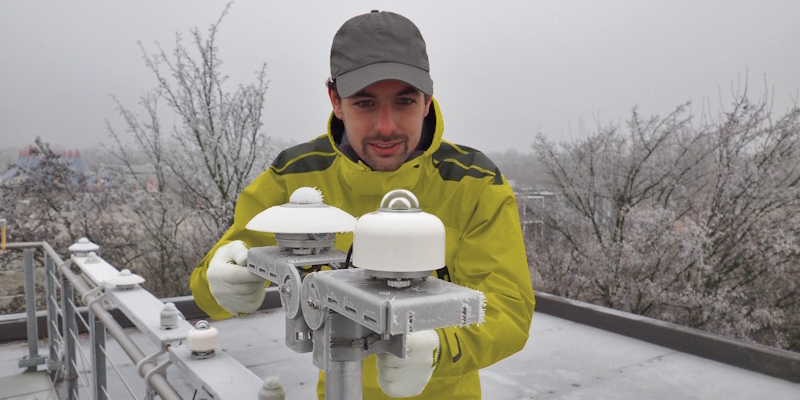
In WMO-No. 8, Guide to Meteorological Instruments and Methods of Observation, WMO recommends the use of spectrally flat Class B or “good quality” pyranometers, such as the Hukx model SR100-D1 for network operation. Modern networks often use one level higher: spectrally flat Class A, for example our models SR300-D1 and SR200-D1.
Hukx’s sensors have passed validation and acceptance testing for many National Meteorological Networks. Here are our references* from 2013 to 2025:
- India: National Institute of Wind Energy (NIWE) solar resource assessment network
- USA: National Ecological Observatory Network (NEON), observation network
- UK: Centre for Ecology & Hydrology (CEH), measurement/monitoring network
- India: India Meteorological Department (IMD), national measurement network
- Japan: Japan Meteorological Agency (JMA), national measurement network
- China: China Meteorological Administration (CMA), national measurement network, through a technology transfer project.
- Ecuador: National Meteorological and Hydrological Institute (INAMHI), national measurement network
- USA: The Atmospheric Radiation Measurement (ARM) multi-laboratory network of the U.S. Department of Energy (DOE)
- India: Defence Geo-Informatics Research Establishment (DGRE) climate observation network in the Indian Himalayas
*NOTE: a sensor being tested or used in a network does not constitute a formal endorsement by the test institute or network owner.
Use for diffuse radiation measurement
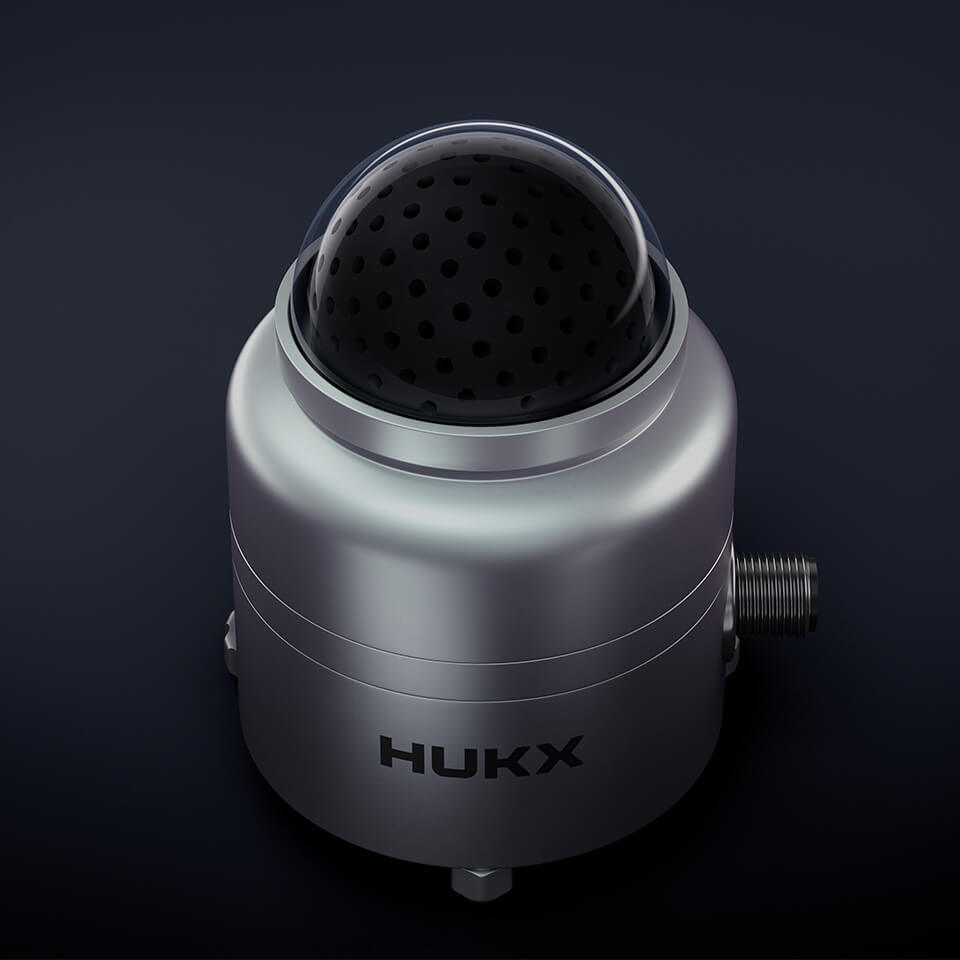
Diffuse solar radiation can be measured by diffusometers, such as our SRD100-D1 (see below), or shaded pyranometers. For the latter, the dominant measurement error is the zero-offset a.
SR300-D1, equipped with internal ventilation, has very low offsets. It outperforms the quartz dome instruments, traditionally used for this purpose, at a much lower cost level.
Instrument cleaning and calibration
The performance of high-class instruments heavily depends on cleaning. At a low maintenance level, the achievable accuracy will not be reliably attained. Consider using multiple instruments as the use of redundant instruments allows for remote checks of one instrument using the other as a reference, leading to a higher measurement reliability.
For lower-class instruments, the relative loss of accuracy at a low maintenance level is less significant. At low maintenance intervals, the use of multiple low-class instruments is a good alternative to using a single high-class instrument.
Electrical interfacing
We can assist you in optimizing the interfacing of the pyranometer to your data collection platform. Solutions vary from using a data logger as a local connection point for several different sensors to using transmitters incorporated in the pyranometer.
For the solar PV industry and meteorological networks, the ideal solution is the SR300-D1 pyranometer. Key features of this model include digital output and sensor communication using the industry-standard Modbus RTU protocol over 2-wire RS-485.
Related products
More application notes
All application notes


We like having a good technical conversation
Do you have questions, need help finding the right solution, or looking to discuss an instrument for a unique application? Our technical engineers provide expert advise. Contact us now!