TRSYS20
Building thermal resistance measuring system with two measurement locations
Request a quote
Ask your question
- reliable & robust
- high accuracy
- high sensitivity
- intuitive interface
Building thermal resistance measuring system with two measurement locations
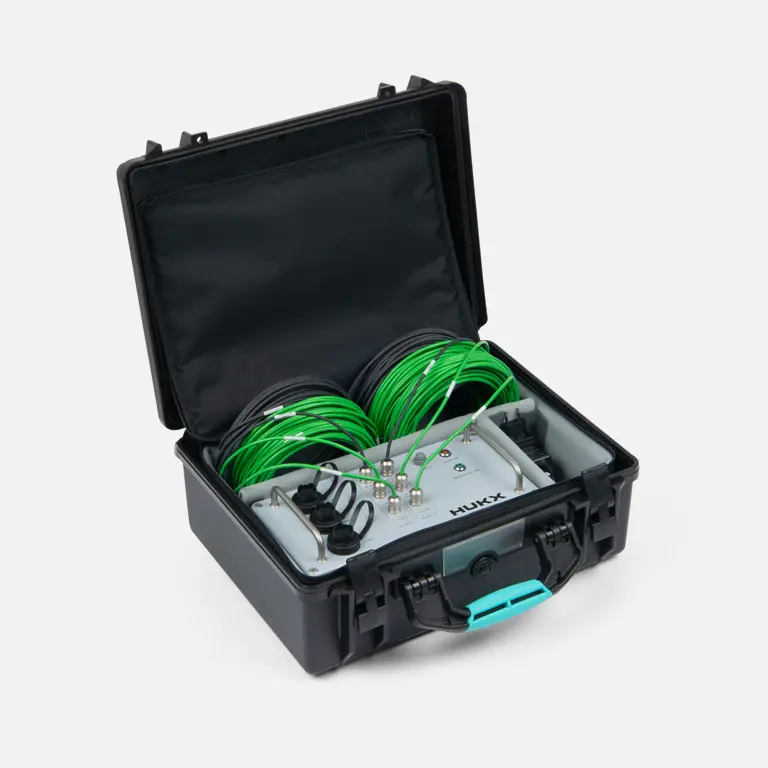
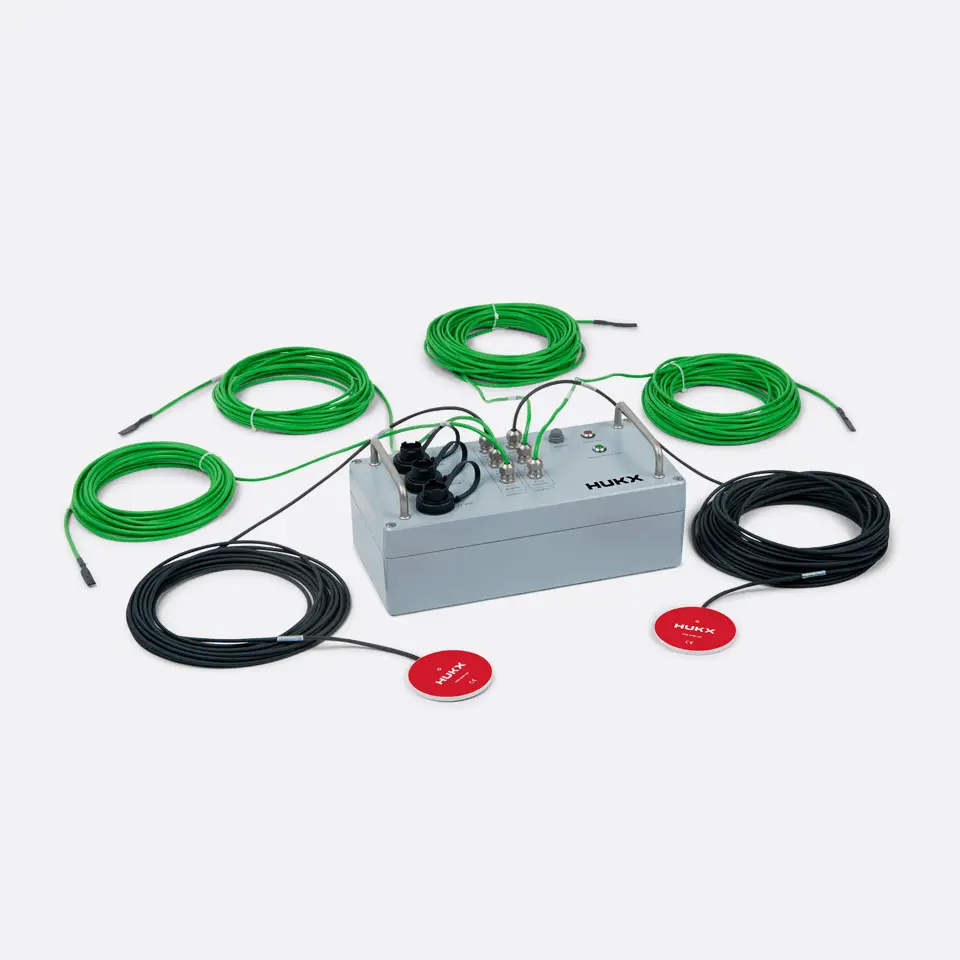
TRSYS20 is a high-accuracy measuring system used in determining the in-situ thermal resistance (R-value), thermal conductance (Λ-value), and thermal transmittance (U-value) of building envelope components. The system is mostly used for measurements according to standard practices of ISO 9869, ASTM C1046 and ASTM C1155. TRSYS20 is equipped with high-resolution electronics, two heat flux sensors of model HFP01 as well as two pairs of matched thermocouples for differential temperature measurements. The high-sensitivity heat flux sensors combined with the robust, high-resolution electronics ensure that TRSYS20 continues making meaningful measurements when other systems no longer perform; in particular at very low heat fluxes and low temperature differences across the wall. The matched thermocouple pairs allow measurement of temperature differences with an uncertainty better than 0.1 °C over the entire temperature range. Two measurement locations provide redundancy allowing the user to verify that the measurement results are representative for the building envelope component.
- reliable & robust
- high accuracy
- high sensitivity
- intuitive interface
Specifications
| standards governing use | ISO 9869 ; ASTM C1046 ; ASTM C1155 |
| MCU graphical user interface | web page via web browser |
| number of measurement locations | 2 |
| rated operating temperature range HFP01 and TC | -30 to +70 °C |
| heat flux sensors | |
| – measurand | heat flux (2 x) |
| – uncertainty of calibration | ± 3 % (k = 2) |
| – heat flux measurement resolution | 0.02 W/m² |
All specifications
| standards governing use | ISO 9869 ; ASTM C1046 ; ASTM C1155 |
| MCU graphical user interface | web page via web browser |
| heat flux sensors | |
| – measurand | heat flux (2 x) |
| – uncertainty of calibration | ± 3 % (k = 2) |
| – heat flux measurement resolution | 0.02 W/m² |
| – guard width to thickness ratio | 5 m/m (as required by ISO 9869 D.3.1) |
| TC matched thermocouple pair | |
| – measurand | temperature difference (2 x) |
| – accuracy | < ± 0.1 °C (as required by ISO 9869, paragraph 5.2) |
| – resolution | 0.02 °C |
| thermocouples | |
| – measurand | temperature (4 x) |
| – thermocouple type | IEC 60584-3: 2007 type KX |
| – tolerance class | Class II |
| required data analysis to determine building R-value and U-value | to be performed by the user according to ISO and ASTM standard practices |
| number of measurement locations | 2 |
| cable length per location | location 1: 10 m ; location 2: 20 m |
| rated operating temperature range HFP01 and TC | -30 to +70 °C |
| measurement duration range | > 3 days |
| data storage capacity | > 30 days |
| MCU specifications | |
| – connection | to local area network (LAN) via ethernet or directly to PC via USB |
| – supported web browsers | Chrome 10 ; Firefox 4 ; Internet Explorer 9 ; Opera 11 ;Safari 5 ; or later |
| – rated operating voltage MCU | 10 to 16 VDC |
| – ingress protection class | IP54 |
| PSU specifications | |
| – input voltage | 110-220 VAC, 50 / 60 Hz |
| – ingress protection class | IP22 |

Interested in this product?
Let's talk about your project and the performance data you need. We are here to guide you to the right solution.
The perfect choice for
in-situ building envelope studies
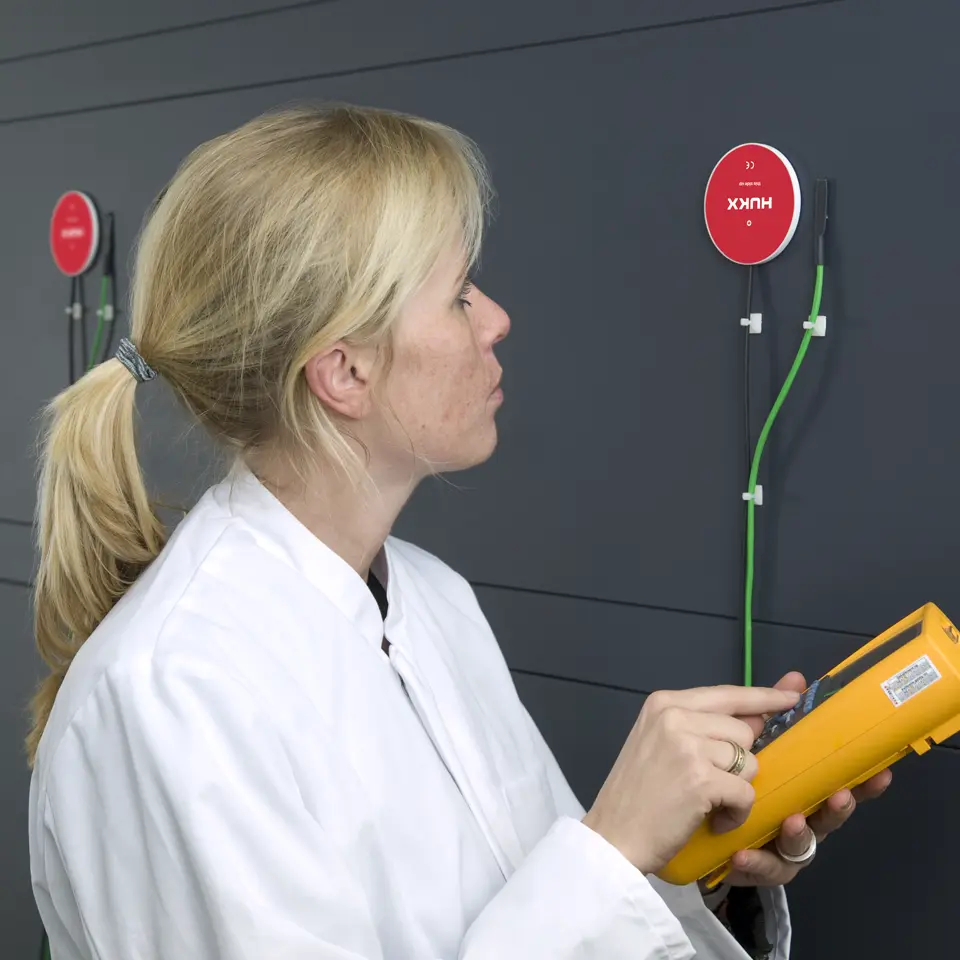
In-situ measurements of thermal resistance or R value are often applied in studies of buildings. Other possibilities are to measure its inverse value, the thermal conductance which is called the Λ-value, or to measure the thermal transmittance or U-value which includes ambient air boundary layer thermal resistance. The measurements of R, are based on simultaneous time averaged measurement of heat flux Φ in W/m2 through the wall and differential temperature ΔT in K across the wall:
R = ΔT/Φ
The ISO 9869, ASTM C0146 and ASTM C1115 standards give detailed directions concerning the measurement method, sensor installation and data analysis. TRSYS20 is a system for measuring the heat flux and differential temperature used in determining the thermal resistance of building envelope components.
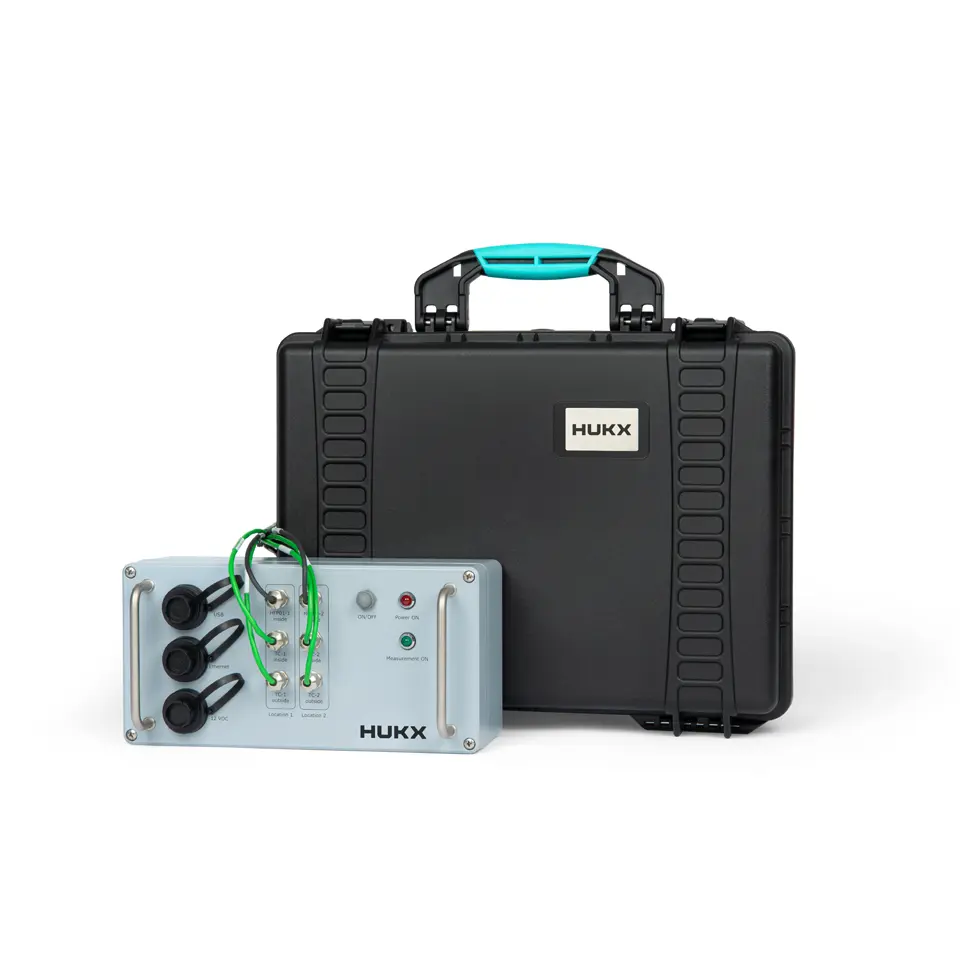
TRSYS20 consists of two HFP01 heat flux sensors, two matched thermocouple pairs, a measurement and control unit (MCU), a power supply unit (PSU) and a carrying case. The high-sensitivity heat flux sensors in combination with the MCU’s high-resolution electronics ensure that TRSYS20 continues to make meaningful measurements down to very low heat fluxes. The matched thermocouple pairs in TRSYS20 measure temperature differences across the wall with an uncertainty of better than 0.1 °C over the entire rated operating temperature range as required by ISO 9869 (Paragraph 5.2).
User interface:
MCU as a web server
TRSYS20 is controlled via a PC. No software installation is required. The measurement and control unit (MCU) can be connected to a local area network (LAN) via Ethernet or directly to a PC via USB. The MCU provides a graphical user interface in the form of a webpage that is accessible through a web browser. The graphical user interface allows the user to start and stop experiments; to monitor real-time heat flux, temperature and temperature difference measurement data; and to review preliminary results.
Typical measurements may last 1 to 2 weeks with a minimum of 3 days. Preliminary data analysis may be required to determine if sufficient data has been collected. To provide a quick assessment of the current dataset, the interface shows a scatter plot of the heat flux versus temperature difference, a time trace of the R-value an several data quality indicators. Using the scatter plot users can check for sufficient correlation in their data set. The time trace allows checking for convergence. The data quality indicators follow the criteria outlined in the ISO 9869 standard.
The system generates a data file, containing the measurement time, heat flux, temperature and temperature difference for the two measurement locations. The data file is stored in the MCU and can be downloaded through the graphical user interface. The user is responsible for the data analysis, calculating the R-, Λ- or U-value of the building envelope according to the ISO 9869 or ASTM C1155 standards.
TRSYS20 advantages
- Robust and stable. Equipped with heavy-duty components, TRSYS20 is a robust and stable system. Its sensors survive repeated installation necessary in this application where measuring systems are typically used at multiple locations over time. The sensors are water - (rated IP67) and corrosion proof.
- Ethernet or USB. TRSYS20 MCU can either be connected to a local area network (LAN) via its Ethernet port or it can be connected directly to a PC or laptop via USB.
- Intuitive and easy to use graphical user interface. The MCU provides a user interface in the form of a webpage, accessible through a web browser. No software installation is required. The graphical user interface provides an intuitive and easy way of controlling and reviewing experiments.
- Simultaneous measurements on two locations. The two measurement locations either provide redundancy, allowing the user to check that the measured values are representative for the wall, or the option to measure two different walls in parallel, saving time.
- High-resolution and high-sensitivity. High-resolution electronics and high-sensitivity heat flux sensors allow TRSYS20 to measure very small heat fluxes through the wall. Sensor cable shielding ensures that the system is insensitive to electrical disturbances as found in industrial environments.
Suggested use
- Heat flux and differential temperature measurement for building R-value, Λ-value or U-value determination.
Areas of application
Related products