What is a pyrheliometer?
A quick introduction to pyrheliometer basics
This note provides readers with a basic technical background an introduction to pyrheliometers and the measurement of direct irradiance.
Introduction
A pyrheliometer is a device that measures solar irradiance coming directly from the sun. The SI units of irradiance are watts per square meter (W/m2). Traditionally, pyrheliometers were mainly used for climatological research and weather monitoring; however, recent worldwide interest in solar energy has led to an increased interest in pyrheliometers.
In this article, we will explore the basic aspects of a pyrheliometer: what does it measure, what is it useful for, and how does it work?

Pyrheliometer: a solar irradiance sensor
Pyrheliometers measure “direct solar radiation” E: the amount of solar energy per unit area per unit time incident on a plane normal to the position of the sun in the sky, coming directly from the sun itself. This is also called “direct normal irradiance”, often abbreviated to DNI.
A pyrheliometer must be mounted on a solar tracker: a device that points the instrument at the sun throughout the day. See Box 1.
This direct radiation E, together with diffuse radiation Ed , gives the total available amount of solar energy on the Earth’s surface, the global irradiance Eg↓:
Eg↓= E ⋅ cos(θ)+ Ed (1)
where θ is the angle between the surface normal and the position of the sun in the sky.

| SOLAR TRACKERS (BOX 1) |
To point a pyrheliometer at the sun, a solar tracker rotates around 2 axes, varying the zenith angle moving up and down and the azimuth angle in the horizontal plane (north, east, south to west. The required pointing is calculated from GPS coordinates, date and time, using a solar position algorithm. Some trackers integrate extra devices (“sun sensors”) to fine-tune the pointing once the sun is visible, achieving pointing accuracies better than 0.1 °. It is important that the tracker remains stable and level for long periods of time, in all weather conditions. Solar trackers are available in many different shapes and sizes. Contact Hukx for suggestions. |

To measure only the radiation coming directly from the sun, it is necessary to limit the field of view of the instrument. From outside the Earth’s atmosphere, the sun is seen as a disk with an field of view angle of about 0.27 °. At ground level, the sun looks a lot bigger. Its visual size depends on the atmosphere: the hazier the sky, the larger the sun appears.
Per WMO (World Meteorological Organization) convention, all modern pyrheliometers use the same field of view, characterized by an opening half-angle of 2.5 °. This means that the measurement of direct solar radiation includes some “circumsolar” radiation.

Direct solar radiation varies greatly depending on the height of the sun in the sky (and thus location on the Earth, time of day, and day of year), and on meteorological and environmental factors such as clouds, aerosols, smog, fog, precipitation, and others. Typical values for the direct solar irradiance are in the range from 0 to the theoretical maximum of the solar constant, about 1361 W/m².
What are pyrheliometers used for?
The sun is Earth’s main source of extra-terrestrial energy. This has important implications in two areas: 1) weather and climate, and 2) energy production by harvesting solar energy.
Solar radiation is one of the driving forces behind the Earth’s weather patterns and is thus an important factor in weather and climate studies. In these studies, pyrheliometers are often combined with pyranometers to measure all components of the solar radiation: direct, global, and diffuse.
Traditionally, large zero offsets and directional errors in pyranometers meant that the measurement of Global Horizontal Irradiance using combined pyrheliometer + diffuse radiation measurement was much more accurate than a measurement using a single pyranometer. However, in the past few years, pyranometers have become much more accurate. Modern pyranometers, such as models SR300, have very low zero offsets and near-perfect directional responses. Nevertheless, a separate measurement of direct and diffuse radiation (instead of only global radiation) is still the standard in high-accuracy installations, such as in the Baseline Surface Radiation Network (BSRN).
In particular, when adding a separate pyranometer for an independent measurement of GHI and measuring all three components allows users to check for internal consistency by comparing the global radiation to the “back-calculated” global radiation derived from direct and diffuse radiation.
In the solar energy industry measurements with pyrheliometers, combined with those with pyranometers, are used to monitor the performance of photovoltaic (PV) power plants. By comparing the actual power output from the PV power plant to the expected output based on solar radiation data, the efficiency of the PV power plant can be determined. Pyrheliometers can also be used to determine the suitability of potential sites for PV power plants. In this case, pyrheliometers are used to estimate the expected yield of a PV installation.
For PV installations that use concentrated sunlight, monitoring the direct solar radiation is necessary to ensure proper operation of the plant.
Finally, a pyrheliometer provides the most accurate method of measuring sunshine duration. The WMO defines sunshine hours as “the sum of the time intervals (in hours) during which the direct normal solar irradiance exceeds a threshold of 120 W/m2.

How does a pyrheliometer work?
Pyrheliometers are irradiance sensors that incorporate thermopiles: sensors based on the Seebeck, or thermoelectric, effect. The main components of a pyrheliometer are a quartz window, a black absorber, a thermopile, the pyrheliometer tube (which together with the apertures at the sensor and the quartz window defines the acceptance function), and, in some cases, additional electronics. Sights are included to enable the instrument to be pointed correctly.
The window on a pyrheliometer acts as a filter that transmits solar radiation with wavelengths from roughly 200 nm to about 4000 nm (this contains the near-infrared, visible UV-A and part of the UV-B radiation, see Figure 3), but blocks thermal radiation with wavelengths longer than 4 µm.
The window and sensor housing serve to protect the black absorber and the thermopile from the elements (i.e., rain, snow, etc.).
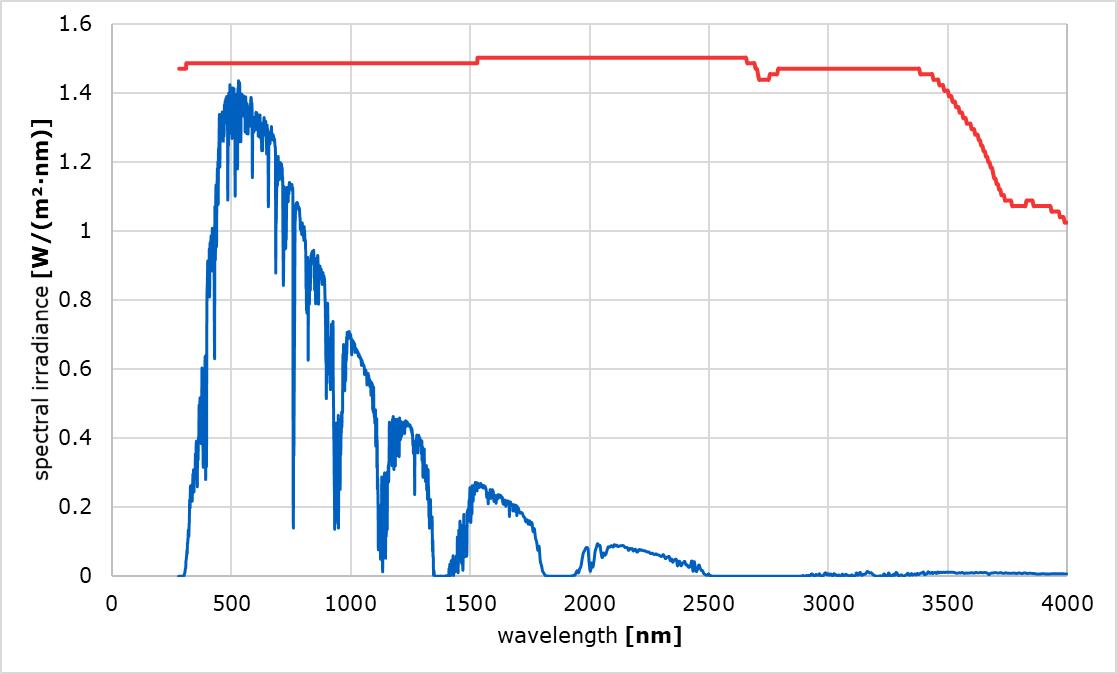
The radiation passing the window is absorbed by the black surface of the pyrheliometer sensor and converted into heat. If the transmission through the window is τ, the area of the black surface is A, and the absorption coefficient of the black surface is α, then the heat absorption can be calculated as follows:
Pabsorption = α ⋅ τ⋅ A ⋅ E (2)
This creates a temperature gradient from the black surface through the thermopile to the pyrheliometer body, which acts as a heatsink. The temperature difference is given by:
ΔT = Rthermal ⋅ Pabsorption (3)
where Rthermal is the thermal resistance of the thermopile sensor. This thermal resistance depends on the specific composition and geometry of the thermopile sensor.
Related products
More application notes
All application notes


We like having a good technical conversation
Do you have questions, need help finding the right solution, or looking to discuss an instrument for a unique application? Our technical engineers provide expert advise. Contact us now!